Campaign
How do I use the engagement pixel?

Author
Koray Soygün
30 Apr 2026
Measure important user interactions on your website and analyse the quality of your campaign traffic.

Overview
With the Engagement Pixel from AdUp Technology, you can measure interactions that are not directly considered conversions, but still provide important signals for campaign evaluation.
These include, for example:
Page views
Scroll depth
Time spent on page
Clicks on specific elements
Views of individual content areas
The Engagement Pixel helps you better understand user behaviour and optimise campaigns based on data.
How Engagement Tracking works
The Engagement Pixel is triggered on specific pages or during defined user actions.
Unlike the Conversion Pixel, the Engagement Pixel does not measure completed conversions, but rather interactions along the customer journey.
This allows you, for example, to analyse:
which content is particularly relevant
how far users scroll on a page
which landing pages are performing well
which campaigns deliver high-quality traffic
Tracking takes place via an embedded pixel.
Create Engagement Code
Step 1: Login
Log in to the Advertiser Frontend with your credentials.
Step 2: Open Pixel Management
Navigate to:
Tools → Engagement Tracking
Step 3: Create new Engagement Code
Click on:
Create engagement code
Step 4: Configure Engagement
Enter:
a unique name
a description of the engagement goal
Examples:
Scroll depth 75%
Blog article read
Product details page accessed
CTA clicked
Step 5: Save
After saving, the new engagement code will automatically appear in the overview.
There you will also find the finished integration code.
Integrate Engagement Pixel on your website
Standard Integration
Embed the Engagement Pixel on the desired page or during the relevant event.
Example:
<img
src="https://d.adup-tech.com/campaign/engagement/[USER_ID]?[PARAMETER]"
width="1"
height="1"
border="0"
alt=""
/>
You can find your individual integration code in the Advertiser Frontend under:
Tools → Engagement Tracking → Actions → Integration Code
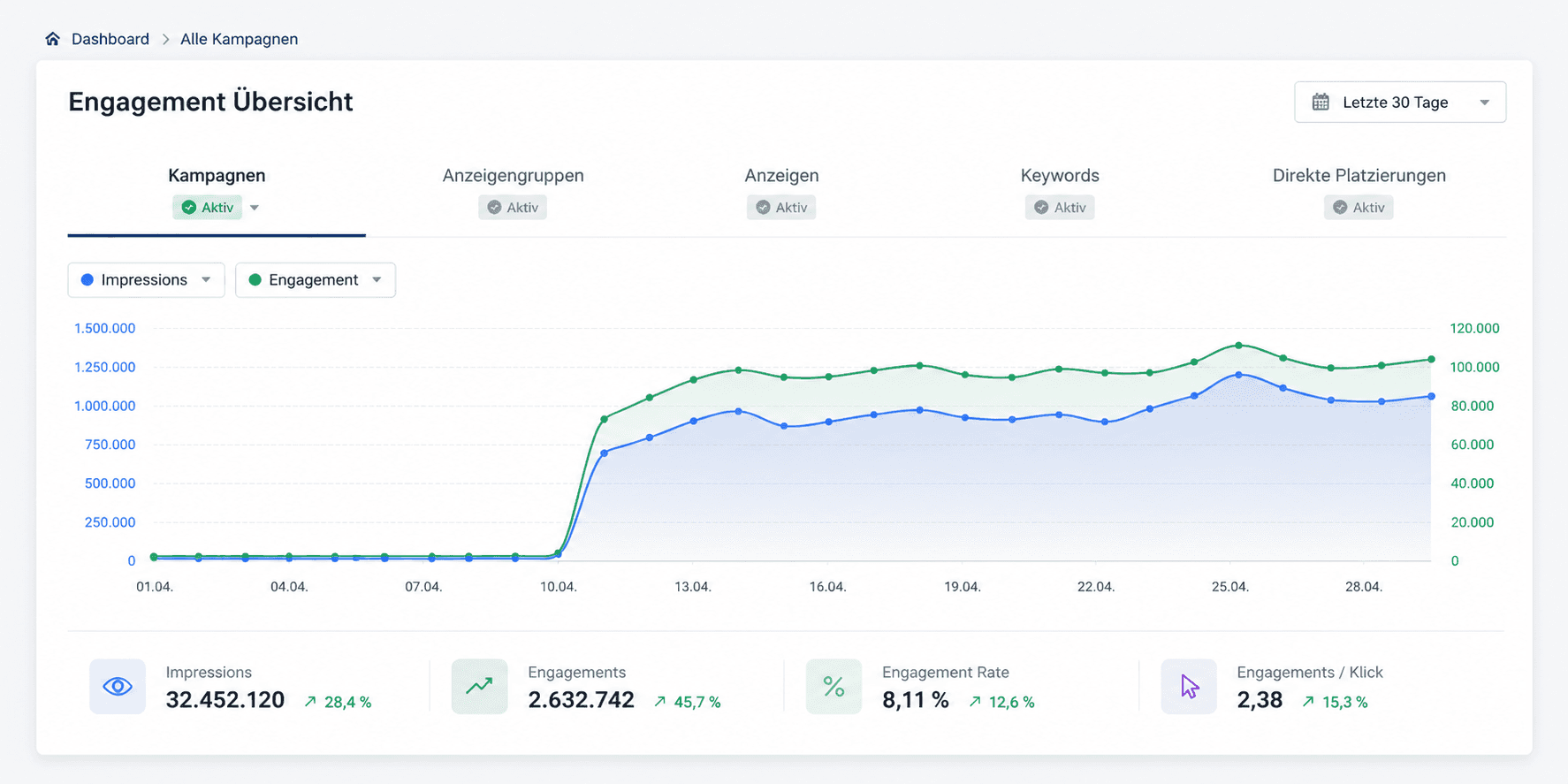
Trigger Engagement Pixel dynamically
The Engagement Pixel can also be loaded on an event basis via JavaScript.
This is particularly useful for:
Scroll tracking
Click tracking
Video interactions
dynamic content
Single-Page Applications
Example:
<script>
const img = new Image();
img.src = "https://d.adup-tech.com/campaign/engagement/[USER_ID]?t=ABCDEF";
</script>
Typical Areas of Application
Measure scroll depth
The pixel is triggered as soon as users have reached a specific area of the page.
Evaluate content engagement
Measure which content is consumed particularly frequently or read completely.
Track clicks on Call-to-Actions
Track interactions with:
Buttons
Forms
Download links
external links
Measure video interactions
The Engagement Pixel can be triggered, for example, during:
Video start
50% playback
complete playback
Required Parameters
Parameter: t
The parameter t contains your unique engagement code.
Requirements
maximum 255 characters
UTF-8 and URL-encoded
Example
t=ABCDEF
Optional Parameters
Parameter: label
Optional label for a more detailed description of the engagement.
Examples:
scroll_75
video_complete
cta_click
Requirements
maximum 255 characters
UTF-8 and URL-encoded
Example
label=scroll_75
Parameter: value
Optional numerical value for the measured engagement.
Examples:
Scroll depth
Percentage value
Time spent
Example
value=75
Best Practices
Track only relevant interactions
Only measure engagements that actually allow conclusions to be drawn about user interest or campaign quality.
Use consistent naming
Use consistent names and labels so that reports can be analysed more easily later.
Example:
scroll_25scroll_50scroll_75scroll_100
Do not trigger pixels limitlessly
Avoid triggering the same event multiple times within a session, unless this is explicitly desired.
Test tracking after integration
After integration, check:
whether the pixel loads correctly
whether the parameters are transferred correctly
whether events are triggered only once
Common Error Sources
Pixel is triggered multiple times
This can distort engagement values.
Missing event logic
For dynamic events, make sure that the pixel is only triggered under the desired conditions.
Invalid parameter values
Ensure that values are correctly URL-encoded when transmitted.
Differences to the Conversion Pixel
Engagement Pixel | Conversion Pixel |
|---|---|
Measures interactions | Measures completed conversions |
Focus on user behaviour | Focus on goal achievement |
Can be triggered multiple times | Usually triggered once per conversion |
Ideal for content analysis | Ideal for performance measurement |

